Marian Anderson (17th and Catharine)

Image

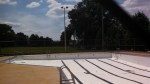
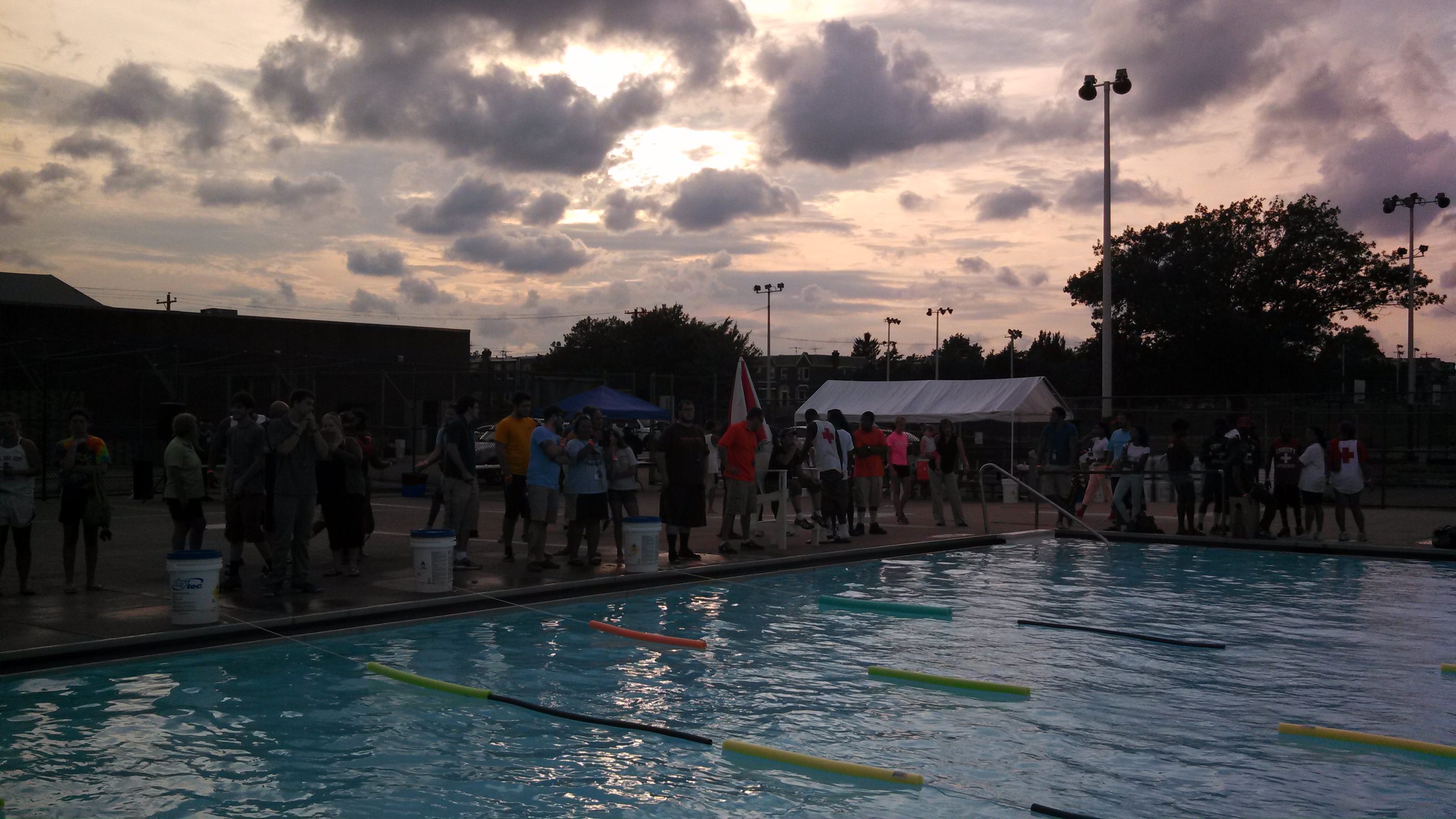
View of the pool from the bleachers.

In my experience, Marian Anderson is consistently the calmest pool in South Philadelphia. So much at the pools can vary from year to year, from day to day, and even from hour to hour. But in the seven years I’ve been visiting Anderson, there has always been space to swim from one end of the pool to the other without bumping into another swimmer.

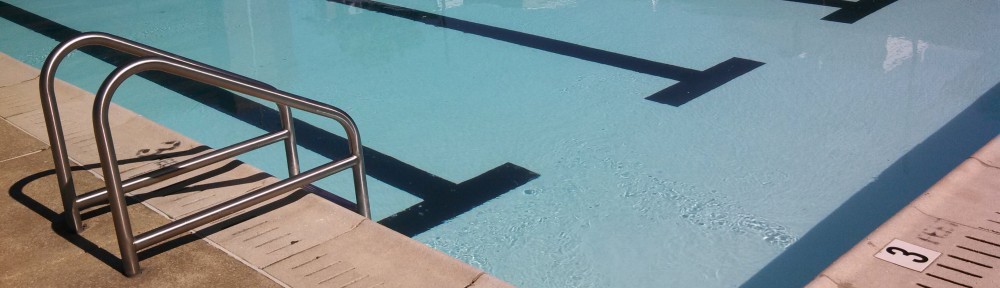
Everyone who swims here showers before entering the pool, because the shower is set up over the pool gate so there’s really no way around it. You need to undress and leave your things on cement bleachers outside the chain-link fence (raised up from and separated from the street by another fence, and clearly visible from the pool). The pool itself is an irregular pentagon shape, with big trees shading the deep end (or deep-er end, at 4 feet 10 inches) and a view of Center City’s buildings beyond. There are lines on the bottom of the pool for lap swimming, and I met a man last summer who was learning how to swim from the “old heads” (his words) who do laps here on weekday afternoons.

Originally called McCoach Playground, the rec center bounded by Fitzwater and Catharine Streets to the north and south and 17th and 18th to the east and west was re-dedicated in honor of Marian Anderson in 1954. Anderson, the legendary contralto and trailblazer (among her many accomplishments: being the first African American to sing with New York’s Metropolitan Opera), was born in Philadelphia in 1897 and grew up in this area. The Marian Anderson Historical Society at 762 South Martin Street, in a house where she lived for nearly twenty years, sits a block and a half from the pool.

A few days after Anderson’s death in 1993, the Inquirer’s Acel Moore remembered her (and the neighborhood in which they’d both grown up) in a piece that includes this pool history: “The old facility was the only playground in South Philadelphia where black children were welcome, and its outdoor swimming pool was the only place in the city – other than the Christian Street YMCA – that blacks could go swimming, public or private, up until the mid ’50s.” Knowing that, it makes even more sense that this particular pool is named for this great Philadelphian.

“Contested Waters: A Social History of Swimming Pools in America”

Image

I was excited to find this book (written by Jeff Wiltse, a history professor at the University of Montana; published by the University of North Carolina Press in 2007) at the Free Library of Philadelphia.

I was even more excited that the Introduction begins:

In 1898 Boston’s mayor Josiah Quincy sent Daniel Kearns, secretary of the city’s bath commission, to study Philadelphia’s bathing pools. Philadelphia was the most prolific early builder of municipal pools, operating nine at the time. All but three were located in residential slums and, according to Kearns, attracted only “the lower classes or street gamins.” City officials had built the austere pools during the 1880s and 1890s — before the germ theory of disease transmission was popularly accepted — and intended them to provide baths for working-class men and women, who used them on alternating days.The facilities lacked showers, because the pools themselves were the instruments of cleaning. Armed with the relatively new knowledge of the microbe, Kearns was disturbed to see unclean boys plunging into the water: “I must say that some of the street gamins, both white and colored, that I saw, were quite as dirty as it is possible for one to conceive.” While the unclean boys shocked Kearns, blacks and whites swimming together elicited no surprise. He commented extensively on the shared class status of the “street gamins” and their dirtiness but mentioned their racial diversity only in passing. Nor did racial differences seem to matter much to the swimmers, at least not in this social context. The pools were wildly popular. Each one recorded an average of 144,000 swims per summer, or about 1,500 swimmers per day.

In the first chapter, Wiltse mentions that one of the first municipal pools in the U.S. was Philadelphia’s “swimming bath,” which opened in June 1884 at 12th and Wharton Streets. I live about fifty feet from that intersection (where, sadly, there is no longer a pool). I cannot wait to read more.

Inspiration for Exploration

Image

Lifeguard swim meet at Vogt Pool, August 8th, 2013.

Even better than my summer as a lifeguard was the training I needed to do to get there. It was satisfying to learn how to do CPR and how to get an injured person out of the water safely. And I was impressed with the maturity and seriousness of my fellow trainees, most of whom were (no exaggeration) half my age. But what really made the training was the lead trainer, an absolutely fascinating Philadelphia character named Larry Brown. Larry conducted most of the twice-weekly, three-hour trainings in a shout, which echoed off the walls of the Sayre-Morris Rec Pool, alternately sounding like an army drill sergeant and a beleaguered uncle. For religious reasons, he swam fully clothed. Long sleeves. Long pants. Boots. And – fully clothed, not to mention being, at this point in his life, a grandfather – he could swim the entire length of the pool underwater without coming up for air.

Larry has been a Water Safety and Lifeguard Instructor in Philly for over twenty years. As such, he not only trains incoming lifeguards but during the summer pool season travels around inspecting safety and operations at pools across the city. He knows every neighborhood in the city – what they’re like now, and what they used to be – because he knows every pool and a sizable number of the people who staff them. I loved talking to him and Thelma, the other WSI running the training – hearing their perspectives on Philly’s people, places, and of course pools. And beyond the shouting (from Larry) and the lectures (Thelma’s specialty), the two of them really bent over backwards to make sure we all got trained right. I’m not sure how many one-on-one make-up sessions they had to do for classes we missed, whether for work trips (me) or senior proms (everybody else), but there were a lot.

A few weeks into lifeguarding at O’Connor, I decided that I too wanted to know all our city pools. My plan was to swim in all 70. I made it to 33, and swam in even fewer (some were drained, or draining; one was filling back up after an accidental draining). Next summer I’ll start earlier.

In the meantime, I don’t want to stop exploring the pools. And so, given that it’s off season, I’ll be doing that here.

Pool City

O'Connor Pool on a cool day in July.

O’Connor Pool on a cool day in July.

I’d lived in Philadelphia for four years before I learned about our city pools. I knew about some of the private pools (whose fees meant I wasn’t going swimming anytime soon), and I’d cooled off many a day in the fountains along the Ben Franklin Parkway, but the fact that there were six dozen free (and legal) swimming spots in my adopted city had somehow eluded me.

And then, on a sticky, muggy, get-out-of-the-shower-and-immediately-begin-to-sweat day in July 2006, I was riding my bike a few blocks from my then-house when I spied a group of people wrapped in towels, emerging from behind a brick wall I’d passed a thousand times. It had never occurred to me that there might be anything interesting behind that wall, much less something that would fundamentally change my experience of summer in the city.

Philadelphia has 70 outdoor public pools that open during the summer, as well as five indoor public pools that stay open year-round. That’s more free outdoor places to swim than in any of the four US cities that boast larger populations than our 1,547,607. (New York’s got 53 outdoor pools – plus 12 indoor ones that cost money to use – for a population of 8,336,697. LA’s got 47 outdoor -plus 7 indoor – for 3,857,799; Chicago 50 outdoor – and 26 indoor – for 2,714,856; Houston 37 for 2,160,821.)

That first pool I stumbled upon back in 2006, O’Connor, takes up the block of South Street that runs between 26th and Taney. After seven summers of squeezing in visits around an increasingly demanding work schedule, I got to spend this past summer poolside, lifeguarding at O’Connor 35 hours a week. (I may have been a little out of place. My boss Natalia, our “LG2,” or head lifeguard, celebrated her 20th birthday three days after I celebrated my 35th.) I saved a few lives. Mainly I just sat there. It was occasionally boring. But in those moments, I’d look up at the sky and remember that it was summer, that I was outside, that I was getting paid to sit by the water and make sure the kids of our city could enjoy the glory of a swim without it being their last. Life was good.

Nothing gold can stay

The last of Philadelphia’s 70 outdoor public pools closed for the season a month ago today. Many of them were drained well before.

Like any organization, the City of Philadelphia Department of Parks and Recreation (which runs the pools) has its quirks and dysfunctions. And I know that the pools cause some of the people tasked with overseeing them a lot of stress. Handling the public. Dealing with packs of temporary and mainly younger staff. Most of all trying to avoid tragedies, like the drowning of seven-year-old Jabriel O’Connor at Cobbs Creek in July, may he rest in peace.

But from my vantage point, Philly’s public pools are golden, magical summer places, and I can’t wait til they reopen in June.