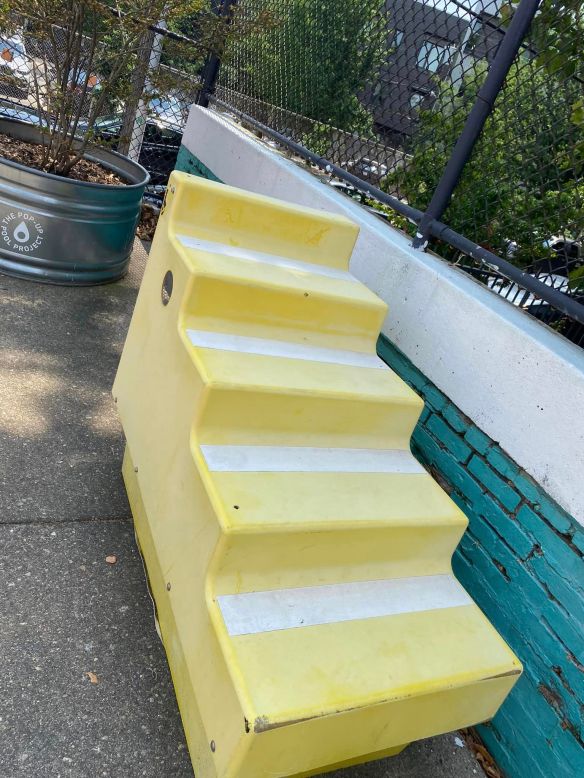
A high accessibility priority is adding stairs to every existing pool that does not have them built into the pool itself. In 2024, Francisville Pool had a nice set of portable stairs sitting out on the pool deck that can be put in the pool upon request, while other pools have stairs, (better yet stairs with handrails) built into the infrastructure. Currently there are a large number of city pools that only have ladders to enter or exit the water. A twin to this portable staircase (or maybe the same exact stairs) was spotted in a pre-season senior swim at Lincoln High School in 2025. Why are pool stairs so important?
According to Wikipedia 45% of Philadelphia’s residents are are over the age of 45. And while age is not a sole factor regarding accessibility, it does play a part: Consider that a very healthy able bodied athlete may perform wondrous feats in youth but experience injury or muscle/joint wear and tear that impacts them later in life. Consider also younger parents among the more than 40% of adults aged 18-44 with infants, toddlers or preschoolers: not only can childbirth impact joints, knees and spine, but any parent will need to lift small children, who themselves make up 6% of the population according to recent census data.
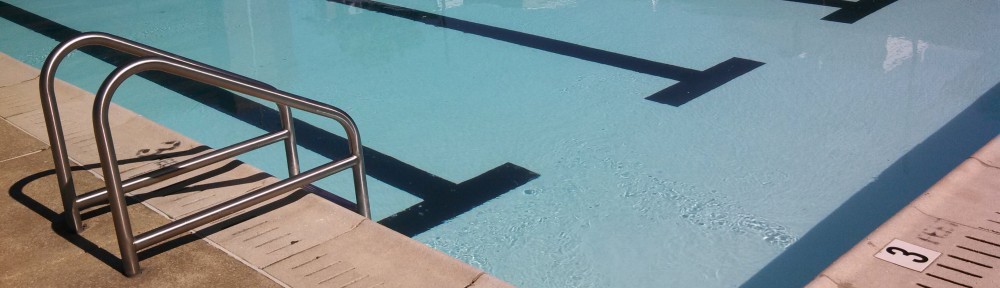
Why not just ladders? Embarrassing (and sometimes traumatizing) moments occur when folks discover that they cannot exit the pool via the default ladders. These people must ask staff or other guests for help and hope that they are willing/ able to assist.
What makes the ladders so difficult? Sometimes it is knees and ankle issues that make ascent from the pool via a ladder difficult and sometimes it is lack of upper body strength to either pool oneself up using the ladder rails or to jump up on the side of the pool without a ladder. Either way, ladders are not a viable access solution for a huge portion of the population, and some ladders are more difficult to navigate than others. For example it turns out that the ladders are especially difficult to navigate at Fletcher (Mill Creek) Pool and Penrose Pool with more than 18″ between the lower rung of the ladders and the floor of the pool. With only two ladders per rung, it is difficult to manage- These specific pools shoud be high on the list for retrofitting with stairs (see below).

| Location | Shallow/ Tot Area Notes | Stairs Notes |
| 12th & Cambria Pool | 2′ tot section | Stairs/ no handrails |
| American Legion Pool | 2″ tot section | No stairs observed |
| Athletic Pool | 3′ tot section with slide | Mulitple stairs with handrails |
| Barry Pool | 2′ tot section | No stairs observed |
| Cecil B. Moore Pool | 2′ tot section | Stairs/ no handrails |
| Cione Pool | 2′ tot section | Stairs/ no handrails |
| Cohocksink Pool | 2′ tot section | No stairs observed |
| Cruz Pool | N/a | Stairs/ no handrails in shallow corner |
| Ellis Pool | 2′ tot section | No stairs observed |
| F.J. Myers pool | 2′ tot section | Stairs with Handrail |
| Fox Chase Pool | 2′ tot section | No stairs observed |
| Francisville Pool | N/a | Portable stairs (no handrail) maybe available? Call |
| Heitzman Pool | 2′ tot section | No stairs observed |
| Jacobs Pool | 2′ tot section | Stairs with handrail |
| Lackman Pool | 2′ tot section | Stairs w/ low handrail |
| Lincoln HS Pool | N/a | Portable stairs (no rails) may be requested |
| Mander Pool | N/a | Stairs with handrail |
| Max Myers Pool | N/a | Stairs/ no handrails in shallow corner |
| Mitchell Pool | 2′ tot area | Stairs/ no handrails |
| Morris Estate Pool | N/a | Stairs/ no handrails in shallow area |
| O’Connor Pool | 2′ tot area | Stairs/ no handrails in shallow area |
| Piccoli Pool | 2′ tot area | No stairs observed |
| Pleasant Pool | 2′ tot area | Stairs with handrail |
| Ridgway Pool | 2′ tot area | No stairs observed |
| Scanlon Pool | 2′ tot area | No stairs observed |
| Simpson Pool | 2′ tot area | Stairs with handrail |
| Stinger Pool | 2′ tot area | No stairs observed |
| Tustin Pool | 2′ tot area | No stairs observed |
| Vogt Pool | N/a | Stairs with handrail |
| Ziehler Pool | 2′ tot area | Stairs no handrails |
Why are separate tot areas important?
The younger a child learns to swim, the better the odds that they will not drown. This means that infants can learn to swim if their parents teach them or have them taught.
The shallow ends of many rectangular and even T-shaped public pools start at 3′ which is fine for adults but deeper than many younger kids are tall. Also the shallow ends often fade into deeper water without clear visual markings to warn kids or guardians that they are venturing in too deep!
Previously some Philly public pools such as Lawncrest had separate tot pools, which proved to be difficult and expensive to maintain. Many more recently designed pools have tot areas off to the side of a larger rectangular area for advanced swimmers and adults, and in these pools there is usually a rope divider to assist guards and adult caretakers in identifying a boundary for small swimmers. Typically these tot areas are about 2 ft deep, and often they feature steps so that kids and caretakers can more easily and gradually enter and exit the water. But some tot areas do not have steps, which makes it difficult for parents to carry kids or even just themselves out of the water.

