Philly public swimming pools, like much of Philadelphia’s infrastructure, have multiple opportunities for improving every day accessibility.
Because Philadelphia is an old city with some of the oldest public bathing facilities in the country, physical accessibility did not play as large a role in public planning as it necessarily does in modern times. Many playgrounds were built at the turn of the 20th Century and still stand today with stairs and group showers and gendered restrooms of bygone days. Many of these buildings have since been repurposed and many new, improved playgrounds have been built while others still serve their original purpose and have been (or can be) modified.
All of this is to explain why so many buildings, incuding recreational centers are inaccessible to disabled people, older folks or even young adults carrying kids around. As new rebuilds take place, facilities are improved upon or recreated. It is up to us to assure that accessibility plays a major role in all designs and redeisgns.
The major item is the issue of removing entry stairways or installing ramps or alternative public entrances to spaces that are built with stairs. This is slowly being addressed in most pools and recreation centers and there has been much progress in that regard. However, there are still a few Philly public pools have stairs to the main entrances at least. You will definitely want to call the following pools before travel if you cannot navigate steps to get onto the pool deck.
Current pools that seem to require stairs to access to the pool deck are:
Belfield Pool 2109 W Chew Ave., 19138 (possible accessible etrance thru field/ Rec center)
Gathers Pool 2501W Diamond St., 19121 (possibly accessible rec center entrance)
Kendrick Pool 5822-24 Ridge Ave., 19128
Max Myers Pool 1601 Hellerman St., 19149 (stair-free entrance via ballfield)
Piccoli Pool 1501 E. Bristol St., 19124 (possibly a “back gate” to pool thru playground)
Pickett School Indoor Pool 5700 Wayne Ave, 19144 CLOSED 2024 SEASON (possible access thru school building)


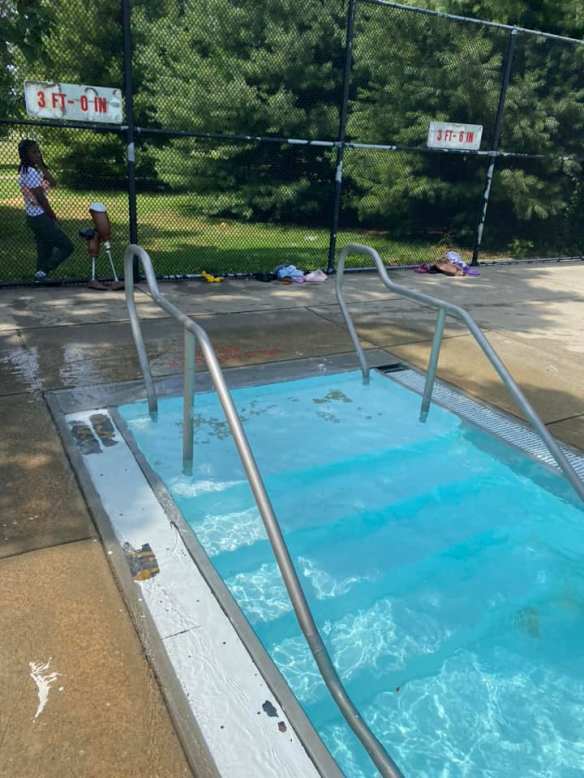
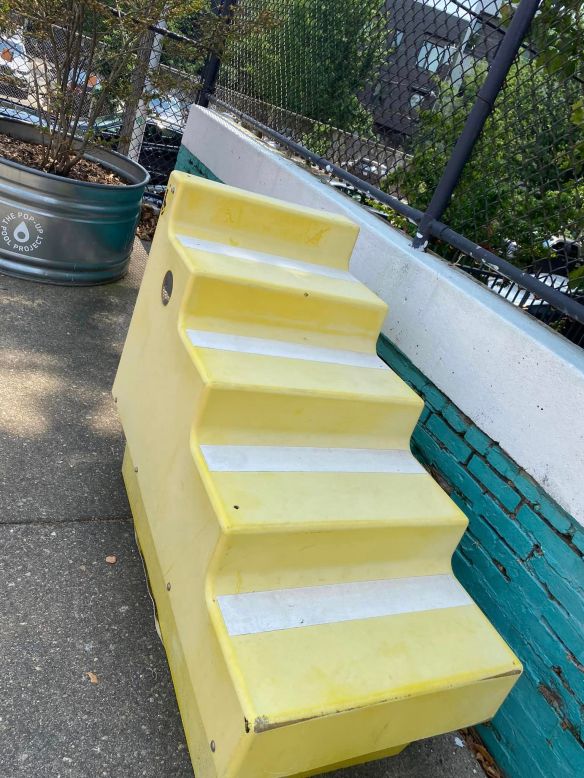
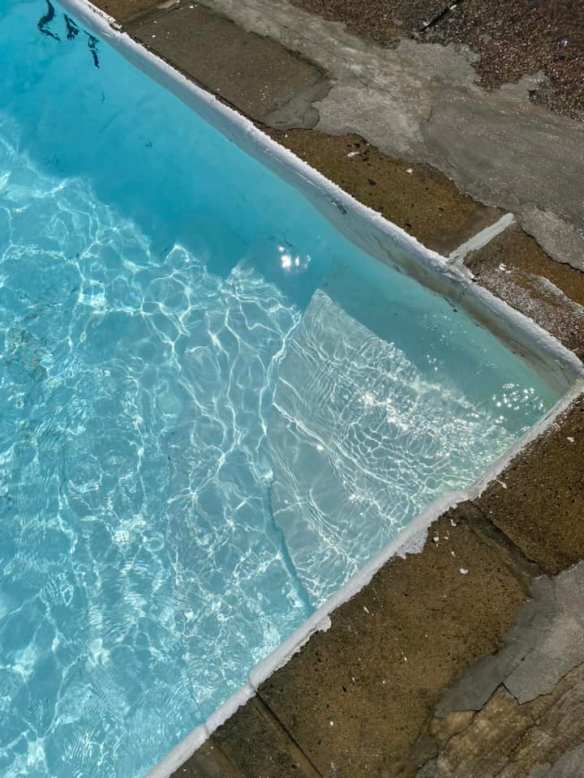
Another priority is adding stairs to every existing pool that does not have them built into the pool itself. Francisville Pool has a nice set of portable stairs sitting out on the pool deck that can be put in the pool upon request, while other pools have stairs, (better yet stairs with handrails) built into the infrastructure. Currently there are a large number of city pools that only have ladders to enter or exit the water.
Which Pools have stairs and shallow/ tot areas?

| Location | Tot/shallow notes | Stairs notes |
| 12th & Cambria Pool | 2′ tot section | Stairs/ no handrails |
| American Legion Pool | 2′ tot section | No stairs observed |
| Athletic Pool 1 | 3′ tot section w/slide | Multiple stairs w/ handrails |
| Barry Pool | 2′ tot section | No stairs observed |
| Cecil B. Moore Pool | 2′ tot section | Stairs / no handrails |
| Cione Pool | 2′ tot section | Stairs/ no handrails |
| Cohocksink Pool | 2′ tot section | No stairs observed |
| Cruz Pool | N/a | Stairs/ no handrails in shallow corner |
| Ellis Pool | 2′ tot section | No stairs observed |
| F.J. Myers pool | 2′ tot section | Stairs w/ handrails |
| Fox Chase Pool | 2′ tot section | No stairs observed |
| Francisville Pool | N/a | Portable stairs available, call ahead |
| Heitzman Pool | 2′ tot section | No stairs observed |
| Jacobs Pool | 2′ tot section | Stairs w/ handrails |
| Lackman Pool | 2′ tot section | Stairs w/ low handrails |
| Mander Pool | N/a | Stairs w/ handrails |
| Max Myers Pool | N/a | Stairs no handrails in shallow corner |
| Mitchell Pool | 2′ tot area | No stairs observed |
| Morris Estate Pool | N/a | Stairs in shallow are, no handrails |
| O’Connor Pool | 2′ tot area | Stairs no handrails |
| Piccoli Pool | 2′ tot area | No stairs observed |
| Pleasant Pool | 2′ tot area | Stairs w/ railing |
| Ridgway Pool | 2′ tot area | No stairs observed |
| Scanlon Pool | 2′ tot area | No stairs observed |
| Simpson Pool | 2′ tot area | Stairs with handrails |
| Stinger Pool | 2′ tot area | No stairs observed |
| Tustin Pool | 2′ tot area | No stairs observed |
| Vogt Pool | N/a | Stairs with handrail |
| Ziehler Pool | 2′ tot area | Stairs no handrail |
Why are separate tot areas important?
The younger a child learns to swim, the better the odds that they will not drown. This means that infants can learn to swim if their parents teach them or have them taught.
The shallow ends of many rectangular and even T-shaped public pools start at 3′ which is fine for adults but deeper than many younger kids are tall. Also the shallow ends often fade into deeper water without clear visual markings to warn kids or guardians that they are venturing in too deep!
Previously some Philly public pools such as Lawncrest had separate tot pools, which proved to be difficult and expensive to maintain. Many more recently designed pools have tot areas off to the side of a larger rectangular area for advanced swimmers and adults, and in these pools there is usually a rope divider to assist guards and adult caretakers in identifying a boundary for small swimmers. Typically these tot areas are about 2 ft deep, and often they feature steps so that kids and caretakers can more easily and gradually enter and exit the water. But some tot areas do not have steps, which makes it difficult for parents to carry kids or even just themselves out of the water.
Why not just ladders? Embarrassing (and sometimes traumatizing) moments occur when folks discover that they cannot exit the pool via the default ladders. These people must ask staff or other guests for help and hope that they are willing/ able to assist.
What makes the ladders so difficult? Sometimes it is knees and ankle issues that make ascent from the pool via a ladder difficult and sometimes it is lack of upper body strength to either pool oneself up using the ladder rails or to jump up on the side of the pool without a ladder. Either way, ladders are not a viable access solution for a huge portion of the population, and some ladders are more difficult to navigate than others. For example it turns out that the ladders are especially difficult to navigate at Fletcher (Mill Creek) Pool with more than 18″ between the lower rung of the ladders and the floor of the pool.. That specific pool shoud be high on the list for tretrofitting with stairs (see below).



Why are pool stairs so important?
According to Wikipedia 45% of Philadelphia’s residents are are over the age of 45. And while age is not a sole factor regarding accessibility, it does play a part: Consider that a very healthy able bodied athlete may perform wondrous feats in youth but experience injury or muscle/joint wear and tear that impacts them later in life. Consider also younger parents among the more than 40% of adults aged 18-44 with infants, toddlers or preschoolers: not only can childbirth impact joints, knees and spine, but any parent will need to lift small children, who themselves make up 6% of the population according to recent census data.
Lap Lanes for fitness, sport and the training of lifeguards
The most popular question asked on Facebook during #MySummerPoolTour2024 (second only to queries about accessible pool entry) was whether there were dedicated lap lanes in each public pool. The sad answer is “No,” at least in most cases.
This is so very sad in light of the historical significance of Philadelphia swim teams like the one coached by JIm Ellis. Without the ability to practice, where will Philly’s next generations of champions practice without having to pay?
Where can lap swimmers work out in philly pools?
Francisville, Cruz, Max Myers and Vogt have extended deeper water areas that naturally attract lap swimmers, although there are not roped off lanes or even lane lines in those locations.
In the 2024 season these were the observed options for lap swimming
1. O’Connor Pool has a roped off lane for laps that is stays roped off even during free swims, although kids jump into that lane freely without correction.
2. Lee Pool added a lap lane (at least for adult swim periods) in July, Francisville, Cruz, has an elongated deep end that is favored by lap swimmer and seems to naturally select for that although it is not part of the planning.
3 Kelly Pool has multiple dedicated lap lanes at all times, a system that should serve as a model for other Philly public pools
Kelly Pool as a system model laps swimming at other pools
In the Olympic sized Kelly Pool there are three ingeniously planned permanent swimming lanes dedicated exclusively to laps swimming. These three lanes account for a vertical half of the pool- one fast swimming lane, one medium speed lane and one slow swimming lane. This plan focused on-duty lifeguards in a more organized fashion- , one guard monitors the lap swimmers and the remaining on-duty guards monitored free swimmers, game players and splashing families in the other half of the pool during free swim.. This System could easily be copied in other pools, especially large pools like Hunting Park, Cobbs Creek , Finnegan and even Gathers as well the L-shaped T-shaped pools with a longer deeper water section like Francisville, Cruz, Max Myers and Vogt
Ask your pool to provide dedicated lap lane swimming because of the benefits:
1. Increasing the safety focus on beginners by separating advanced swimmers
2. Providing space for athletic practice of amateur and professional swimmers
3. Allowing adults / advanced swimmers move freely without interacting with or bumping beginners
4. Encouraging stamina practice for a generation of much needed potential lifeguards of all ages to assuage the current national shortage of lifeguards.
 Swimming Philadelphia