Murphy (3rd and Shunk)

murphy

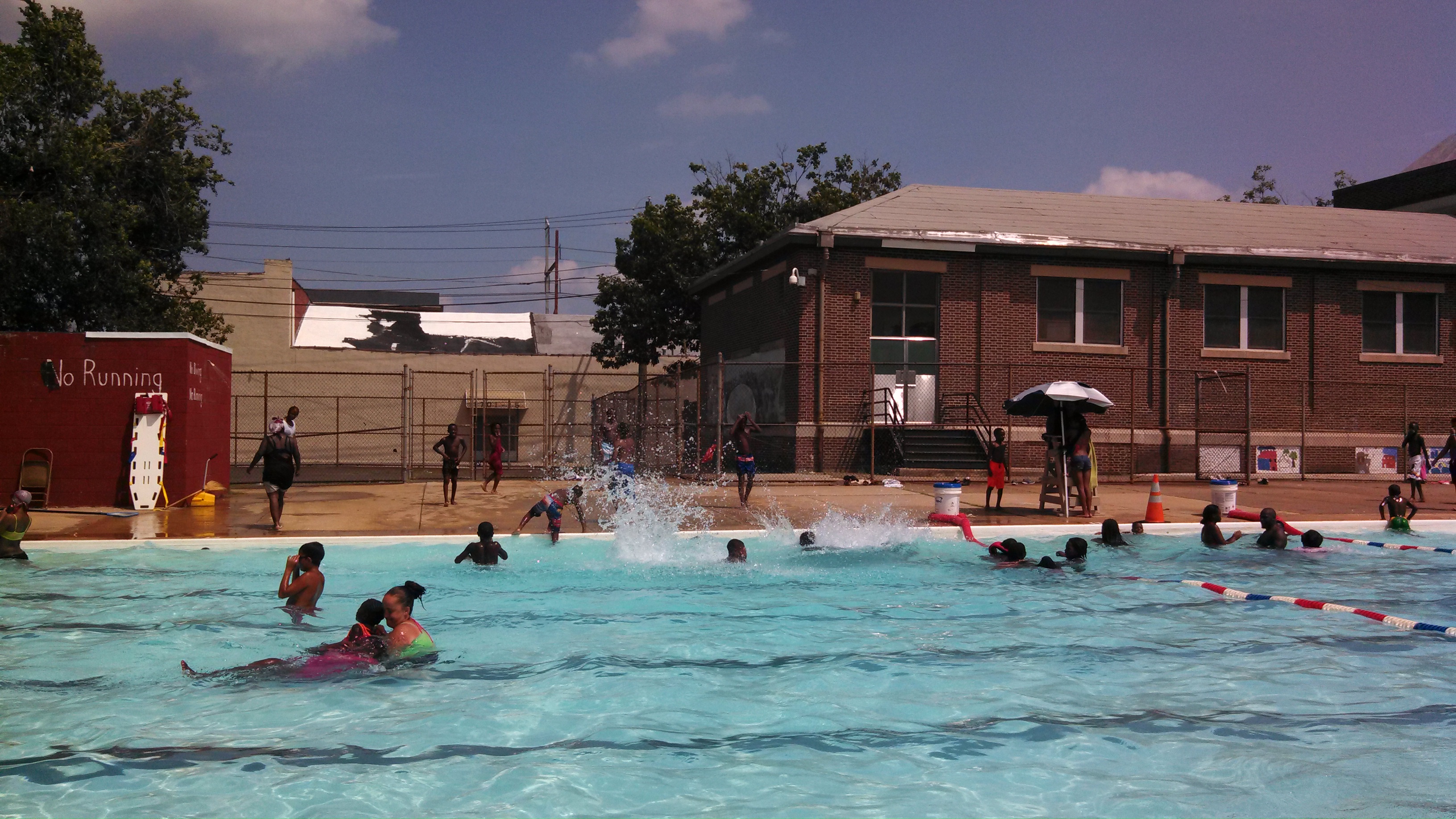
Elevated above the street and bigger than most, the deck at Murphy Pool gets put to good use. Plastic wading pools near the entrance give little kids a shallow spot to get wet. Benches along the perimeter make good spots to dry off. And when head lifeguard Rodger Caldwell blows everyone out of the water for a lecture on pool rules and regulations (as he does a few times a day), it can be nice to have some room to wander around.

There’s been a pool on this corner since 1925, when Murphy was known as the Greenwich Recreation Centre – check out theses great old photographs (under “History”), including one of the brick-wall-enclosed pool (since demolished and rebuilt). Today Murphy hosts huge flea markets and events for everyone from Mummers to the Cambodian Association of Greater Philadelphia in addition to their own programming; in 2002, pro-wrestling outfit Ring of Honor launched their broadcast career here. This isn’t a neighborhood known for its trees, but huge ones line the sidewalks beside Murphy’s fields, creating a visual and psychological separation from Oregon Avenue’s industrial sprawl.

The pool is at 3rd and Shunk; its entrance is up a flight of stairs from the rec center fields.

Barry (18th and Bigler)

335.2

Back in the day, deep South Philadelphia had an especially grand public pool in “the Lakes,” otherwise known as FDR Park. Huge and legendarily awesome, it closed in 1996, leaving the Barry Playground Pool as the only free spot for a swim south of Oregon Avenue. Barry’s been more than up to the task – as this 2010 summer journal attests – except when repairs (in 2002) or budget cuts (in 2009) have kept it dry. Author Jennifer Baldino Bonnet, who learned to swim at Barry and decades later watched her children do the same, calls the pool “a gift from my city.”

In 2001, a kerfuffle over Barry’s gender-segregated swim days resulted in changes at pools city-wide. On July 2nd of that year, Jim Nolan and Carla Anderson of the Daily News reported, “It was 95 degrees in the shade in South Philadelphia on Wednesday, and like any sane person, Anne Marie Ulerick decided to take her 11-year-old daughter and 7-month-old son to the Barry Playground pool for a swim. Seconds after arriving at the well-kept rec center on 18th and Bigler Streets, Ulerick’s daughter jumped in and began frolicking in the refreshing water. But when Ulerick decided to take a dip with her baby boy, she was told to stay out of the pool. The reason? It was ‘girls day’ at the pool.”

Most if not all Philadelphia public pools once held “girls days” and “boys days” – you can see as much on outdated schedules posted on pool gates around the city. Dividing the population along gender lines helped control the number of people trying to swim on any given day, and allayed fears (as old as the pools themselves*) of inappropriate contact among swimsuit-clad young people.

But by July 17th, 2001, two weeks and a flurry of articles after they first shared Ulerick’s story, the DN was reporting that all children five and younger and their parents would be allowed to swim on both boys’ and girls’ days (which was already the case at many of the pools with gender-segregated swims, though not at Barry), and that in future years, pool supervisors would need to provide justification and get approval from Rec Department brass to continue any single-sex swim times.

Barry still takes its rules seriously. While most city pools rely on the department-issued Rules and Regulations signs, Barry’s got additional directives duct-taped to a board by the entrance. (Mind you, this is a service. Plenty of other pools have these same additional rules; you just might not hear about them until you’re en route to breaking them.) These include leaving your belongings outside the pool gate, so leave your valuables elsewhere.

Barry Playground sits between Johnston Street to the north, Bigler Street to the south, and 18th and 19th Streets to the east and west. The pool is on the Bigler Street side, but its entrance is inside the playground and most easily accessed from 18th Street.

* In Contested Waters, Jeff Wiltse writes, “Since their origin in the nineteenth century, sexuality and concerns about sexuality have profoundly shaped the use and regulation of municipal pools. During the Gilded Age and Progressive Era, cities gender-segregated pools in order to protect women’s modesty and protect them from advances by anonymous men. Gender separation also served as a means of social control. It limited the opportunities unrelated males and females had to meet and interact in public, thereby maintaining traditional family authority over mixed-gender socializing and courtship.”

Philadelphia built our first municipal pools in the 1880s as public baths for the poor, most of whom did not have bathing facilities at home. Working-class men and boys of all races bathed on some days; (many fewer) women and girls on others. Swimming gained popularity among women in the early decades of the 20th century (Wiltse: “In 1914 an average of 300 to 500 females swam in each of Philadelphia’s twenty-three outdoor pools each week. By 1934 the city averaged 1,200 to 1,500 female swimmers a day at each of its thirty-nine pools.”), and public pools began allowing men and women to swim together in the 1920s. Not coincidentally, that was also when pools across the northern U.S. started segregating along racial lines.

Ford (Snyder between 6th & 7th)

ford

Hemmed in mid-block, Ford’s got an often trash-filled playground to one side, a bright and busy mural looming over another, and the rumble of Snyder Avenue laid out in front. There are no open fields here.

Steps from one of South Philadelphia’s more notorious corners, “the Ford Recreation Center at 7th Street and Snyder Avenue – a one-time haven for drug sellers – suddenly became the anti-drug rallying point for a neighborhood” in 1990, according to this Daily News piece, which also mentions that the Police Athletic League (PAL) took over center operations that spring. PAL did not take on the swimming spot, however, and Parks & Rec still staffs and runs Ford Pool.

It is the only pool I’ve visited where they asked to search my bag for weapons. From 1911 through the 1950s, 7th and Snyder was the site of the Grand Theater (you can still make out the old “Talkies – Matinee Daily” sign on its castle-like exterior). These days, like in 1990, it’s an intersection with a rough reputation. That being said, as the South Philly Review reflected in this 2009 feature on Ford: “During a bright and sunny mid-summer day, there is no safer place then [sic] a neighborhood pool.”

The pool entrance is on the north side of Snyder Avenue, halfway between 6th and 7th.

Donna DeShazo

Donna

Age: Late 50s

From: West Philadelphia

First pool experience: Kelly Pool in 1962, with her parents

Work with the pools: As a Pool Maintenance Attendant (PMA) and Pool Equipment Operator (PEO, or head PMA) at O’Connor Pool since 2007

Donna DeShazo has worked at O’Connor Pool for seven years and never once been in the water. “On the hottest day, I won’t even get underneath the shower. And people always ask me, people always say, ‘Do you get in the pool?’ No.” But she loves being there. “I love watching everybody else in that water. I love it. I get a joy out of watching people in the pool, that I’m able to watch them. I’m watching over them. I really feel as though God has placed me there to be their covering. To keep them safe, you know what I mean?”

Ms. Donna, as everyone at the pool calls her, has worked at the Overbrook School for the Blind for 26 years. But come summertime, she’s O’Connor’s Pool Equipment Operator. She’s been at the pool longer than any of the other summer staff, has outlasted three Rec Leader supervisors, and carries an authority born of experience as well as seniority. “I know sometimes even down to our staff, I can work their nerves. Because I want the best, you know what I’m saying? I want the best. I’m older, and I know we have young ones that we work with, but I want them to take the job serious.”

When Donna was growing up in Haddington, her mother would put oil in her children’s shoes if they were running wild – and pray for them either way. “That was the covering she placed on us every single day. ‘The prayer of the righteous avails much.’ You got to trust in God. You got to be prayed up every day. That’s what I do, and I continue to do. I trust God to keep us. I trust God to protect us. Because this is world is a wicked world, unfortunately. I just really wish the leadership – the mayor, the governor – to push for the people. It’s not about themselves. It’s not about money. It’s just about the people.”

“When we came up, we had a lot of programs that was given to us, opportunities that was given to us,” Donna reminisces. At Haddington Rec alone, she attended cooking, sewing and dance classes. “For that to happen for our kids would be so great.”

Donna has a son and a daughter, but she’s not just talking about them. “You see a lot of kids that come to O’Connor – parents will put them out early in the morning, to fend for themselves. And the pool – between the pool and the camp at Markward [Playground] – became their home for the summertime. I mean, we had this one particular family of kids that the mother put them out at ten o’clock in the morning. And they were not allowed to come back home until six o’clock in the evening. She gave them no money. They had no clothes. They were raggedy. They would come to the pool; they would go down to the playground, eat their little lunch. They weren’t campers at the playground, but the camp would still feed them. We’re home away from home.”

“We have some kids that have nowhere to go. Parents can’t afford to take them on vacation. The pool is their vacation. These kids need stuff like that. Not even just the kids. Adults. We have adults that come there faithfully. Who work hard each and every day, pay taxes like anybody else, and because they can’t afford to go on vacation, the pool becomes their vacation.”

Donna has a way of talking that invites you to be part of something with her. As often as not, her sentences end with “you know what I’m saying?” or “you know what I mean?” She explains why you’ll never catch her in the water: “I had a bad experience. When I was 11 years old, one of my big sisters called themselves teaching me how to swim. And almost had me drown. And that was a horrible, horrible experience that I need deliverance from,” she laughs. “But I have not gotten deliverance from that. It’s funny. My two kids learned how to swim. My husband know how to swim. Me? No dice.”

Donna’s husband grew up in South Philly, learned to swim at the now-filled-in public pool in “Chicken Bone” – aka FDR – Park, and later became a Navy man. He taught their son to swim at Haddington and Cobbs Creek pools. But he never swam at O’Connor – which, when he was young, was whites-only. Now, Donna says, “This pool is about everybody. It is not about your type or my type. This is for everybody, and it’s for the whole community.”

“I’m at the gate sometimes, but at the same time I’m watching. I’m watching. I’m looking to make sure everybody’s ok, making sure everybody’s doing what they supposed to do. Guys come in who’ve never been there and want to test the waters and dive in the pool when you say no diving. You have patrons where we have a limit, and they have to stand outside, and they wanna cuss you out. You get that. But for the most of it, I have had patrons where even in situations like that, as long as I explain the situation to them, they are so understanding. Like I tell everybody that comes in there: Please just go according to the rules and regulations. We’re here to have fun.”

Risk of getting sick? .0004%

The Centers for Disease Control and Prevention (CDC) released a report last week on “Recreational Water-Associated Disease Outbreaks.” You can read it here, or check out this analysis from RealClearScience Journal, which concludes:

The number of disease outbreaks from recreational water is likely far underreported, but even if every instance were documented, public swimming pools would still come out looking squeaky clean. Judging on available evidence, the stereotype that public pools are slosh pits of disease doesn’t hold water. 301 million people over the age of six swim in public pools each year, and a mere .0004% come home with an infection, and a minor one at that.

Vare (26th and Morris)

324

South Philly’s largest public swim spot, Vare’s pristine waters sparkle between a century-old rec center and its adjacent expanse of threadbare fields. People who’ve been around for a while sometimes refer to the pool as “Gray’s Ferry” for the surrounding neighborhood, a blue-collar community hit hard by deindustrialization and often defined – at least externally – by racism.

Originally built around 1925, the pool (which has been rebuilt since) was in a white section of the neighborhood and did not start integrating until the late 1970s/early 1980s. In response to some particularly scrutinized area incidents of racial violence in 1997, the City committed to funding programming and renovations at nearby recreation facilities – which were both sites of conflict between Irish-Americans and African-Americans, and sites with particular potential for reconciliation and community-building. That commitment included valiant measures to keep Vare’s pool open, including fully or partially draining its 75,000 gallons every night during pool season (to be able to clean up bottles that were thrown in the pool to keep Black swimmers out) and equipping Vare with the largest police presence of any pool in the city.

Vare’s pool still gets drained every night (although I’ve heard now that’s more to keep people from swimming than to clean up hate-fueled debris), and the regular circulation means it’s got some of the freshest swimming water in the city. Its size and shape make it perfect for laps, though when I’ve visited jumps and flips seem to be more common.

Vare Playground occupies the block between Morris and Moore and 26th and 27th; the pool is on the Morris Street side.

Natalia Susul

Natalia

Age: 20

From: Port Richmond

First pool experience: Samuels Pool in 2001

Work with the pools: As a lifeguard at O’Connor Pool from 2010 to 2013

“One of the most important things about growing up,” Natalia Susul reflects from in the thick of it, “is retaining some innocence. You grow up, and so much stuff happens. Everyone has a rough life. Through all the stuff that you’re going through, whether it’s work stuff or family stuff or just life, you have to be honest, be simple. It’s the simplest things in life that are the most important.”

Natalia has the diminutive stature of a gymnast, but her curiosity is huge and honest. She is unflaggingly open-minded and interested in the world – and especially the people – around her.

“With my parents barely knowing the language, they’ve always stressed to me, know as many people as you can. Meet as many people from as many different backgrounds, because you’ll learn something from everyone. It doesn’t matter if they’re rich or if they’re poor. And that was my favorite thing about being a lifeguard. You meet so many different people. There’s doctors that come to the pool. There’s kids in second grade that come to the pool. People of all different backgrounds, of all different jobs, of all different ethnicities can still come to one place and share something in common. Regardless of their income, or regardless of their skin color – regardless of anything. “

Natalia – who, as the LG2 (head lifeguard) at O’Connor Pool, was my boss this past summer – was on track to become a Philadelphia Department of Parks and Recreation lifeguard by the time she was eight. She and her older brother grew up in Port Richmond (“culturally Polish,” she describes it, and fluent in the language) and attended programs at Samuels Rec, up the street from their house, for as long as she can remember. The summer she was to turn nine, her mother enrolled both kids in Samuels’ Swim for Life summer camp. “I’m pretty sure I threw up in the morning, I was so scared,” Natalia laughs. But by the second week, she was swimming in eight feet of water. She returned to the camp for six more summers, and passed the lifeguard certification at the end. She remembers the lead instructor, Mary Beth, as “the best person in the world. We were always messing around: ‘I don’t wanna swim,’ ‘It’s cold,’ ‘Let’s leave.’ Mary Beth always made us stay in the water, always made us swim.”

Natalia’s first year lifeguarding was 2010, when the City reopened all the pools after the massive closures the summer before. All the pools, that is, except for two that didn’t pass inspection – including the one at Monkiewicz Playground, where Natalia’d been hired. “I called Mary Beth. She looked out for her kids. She really didn’t have to! With all the cuts that were happening – I don’t know the full story of what happened with her and her job – but she wanted everyone to have a job; she wanted everyone to get something out of what they worked for. She within a day called all these different people,” and eventually turned up a lifeguard opening at O’Connor, where Natalia’s worked ever since.

“I knew nobody when I was going up there. I was unfamiliar with the area. I had no idea. I was never in South Philly. In the beginning, my first year, I was the only girl lifeguard out of five lifeguards, but everyone was just super nice. I always felt like someone had my back.”

Natalia waves her hands around as she talks, at times almost hopping up and down with enthusiasm, and laughs loudly and often. She radiates positivity, even when she talks about her brother’s death last year, and the hole that left in her family. Now a junior studying physical therapy at the University of Pittsburgh, she attended Catholic school from the time she was four, first around the corner at her home parish, Nativity BVM, and later at Nazareth Academy. Her goal in life is to help others, and the opportunity to do so is one of the things she loves about teaching swimming.

“It’s not just recreational. That’s the best part about swimming in all these pools; you learn a lot too. Swimming in general – it’s a huge confidence booster. It’s always scary to first learn how to swim. There aren’t many people who are comfortable with it in the beginning. I went to swim camp being like, ‘I really can’t swim; I’m not confident at all.’ And then in a week or two I was already on a better level. And now, seeing kids’ reactions when they can finally put their head underwater, and hold their breath. You see their progress. I’m not even a teacher. I’m not anything special; I’m a kid myself. But it’s gratifying – it’s just so nice to know that you helped. Simple things!”

Philly’s pools are part of the reason, Natalia explains, that she “wouldn’t trade growing up in Port Richmond for anything.”

“I loved growing up in a neighborhood, in such a small town but in the city. We’d play ‘til 10 o’clock at night, and then my mom would call us down the street to come in, and me and my brother would be angry – ‘Ahh, we wanna stay out and play!’ And in the morning it was back out, back out on the street. Freedom was our thing. Freedom was our game. We had a park around the corner; we have a bunch of playgrounds down the street.”

“Growing up in the city, we went down the shore every now and then. But the city gets hot; the city gets sweaty; the city gets gross in the summer. Having the pools is not only a way to cool down, it’s a way to be a kid. Through all the troubles of every day, just being a child again, being innocent again, and just frolicking around. Not everybody does have the money to go down the shore, or has the time to go down the shore.”

“Life is a cycle. You grow up, but there’s somebody else that’s also growing up. Try to think back to when you were a kid. Remembering what you had as a kid – the things you loved as a kid – all kids should have. Hopefully the pools will stay open forever.”

Image

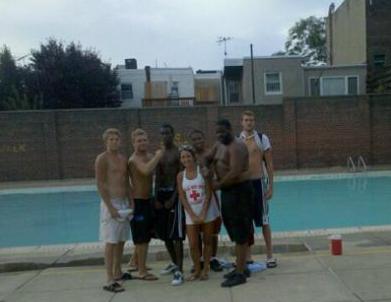
Natalia and other O’Connor Pool staff her first year.
Stinger Square (32nd and Dickinson)

319

Stinger Square is only one square Philly block, but I think of it as a little slice of heaven,” says Irene Russell, President of the Friends of Stinger Square. “Although Stinger Square was established in 1910, it wasn’t until the early 70s that the pool was built. Vare Recreation Center had long been the only pool in Grays Ferry, but Grays Ferry was the most racially volatile area in the city and Vare was in the white neighborhood, which did not want Black kids swimming with their children. So the answer to the problem was to give Blacks their own pool, and that would keep them away from Vare. Since then our children have been swimming in a safe environment that welcomes all ethnicities, and having the time of their lives.”

The gate was closed when I walked up to the pool on a sweaty Saturday in July, so I asked the PMA on the other side if I could come in. “Of course, honey,” she said, taking a momentary break from sweeping the pool deck. “This pool is for everybody.” The bathing-suits-only rule seemed to have gone out the window that day, and a fair number of kids were swimming fully clothed. The lifeguards had enough to handle trying to keep the enthusiastic jumping and flipping games under some semblance of control. “Can you believe I learned to swim in this motherfucker?” I heard one woman laugh to another.

Search through local news archives, and the main things you’ll turn up about Stinger Square are a flurry of reports, every ten years or so, about anti-violence efforts in the area. Talking to Irene Russell paints a much fuller picture. “Stinger Square has always been a safe haven for families to come to, for generations,” she explains. “And the atmosphere at the pool reflects that. It is an air of camaraderie and good wholesome fun. Most of the people who work there are from the neighborhood and familiar with the children and their families so things don’t ever get too far out of hand. It is important to the neighborhood because it is a vital part of our park, which hosts reunions, birthdays, church picnics and many other community events. Also, many summer camps come to the pool so their campers can swim. There is also a high attendance from younger and older adults for adult swim time.”

“Over the years Stinger has evolved with the times. A group of community members formed the Friends of Stinger Square and have been working since 2000 with Parks and Rec, PA Horticultural, the Conservancy, as well as our Council leaders and State Reps to keep our park ‘An Urban Oasis,’ as our welcome sign says. We will be getting a major makeover this winter and look forward to the ribbon-cutting in the Spring. I welcome everyone to come out and visit our park but I must warn you too: ‘Once you do Stinger, you don’t go back!’ But really though, everyone I’ve seen visit our park I’ve seen come back and bring their families with them. They become a part of the Stinger Square family.”

The pool is on 32nd Street between Reed and Dickinson, on the east side of Stinger Square. Wind your way through the family and neighborhood cook-outs to the pool entrance, which is inside the park.

Michael (Kevon) Daniels

Mike

Age: 30

From: West Philadelphia

First pool experience: Kingsessing Pool in 1991 (getting pushed in and nearly drowning)

Work with the pools: As a lifeguard at Kelly Pool for eight summers from 2000 to 2013

With 19 rescues, Michael Daniels saved more people from drowning this past summer than any other City of Philadelphia lifeguard. He takes the role seriously. But ask him why he became a lifeguard – or what motivated him to earn his Water Safety and Lifeguard Instructor certifications this fall – and he’ll tell you, “Chicks dig lifeguards.” He says it with a straight face, but also how he says most things: with laughter soft-shoeing around in his voice, like at any moment it might burst out from in between the syllables.

Mike’s good humor is infectious. It’s humor that grows out of struggle. “I wasn’t always an angel. When I was growing up, I did what the average kids in the urban area do. Spraypaint on walls. Graffiti. Vandalism. Stealing cars. I was bad. I was so bad that in fourth grade I got a EH-21 out of the Philadelphia public school system. In layman’s terms, I got kicked out the school district. I got locked up in a group home type thing. A judge got me back into the school district.”

“My sixth grade teacher was Miss Jeanie Walsh, at William Levering Science Magnet School [now closed] on Ridge and Gerhard in Roxborough. The very first day of school, in sixth grade, I walked into her classroom, and I said, ‘I’m not gonna make it.’ And she looked at me. She tilted her head and lifted her glasses up, and she looked at me, she looked at my name, and said, ‘Michael Daniels, you will make it. I will make sure you make it.’”

“That encouragement she gave me, I never forgot it. I thought I wasn’t going to make it through sixth grade. At that time I don’t know how I made it to sixth grade. I never listened to the teachers; I never stayed in class; I never did my work. The Philadelphia School District is overcrowded. You got like 30, 40 kids to one teacher. I’m not going to say people can’t learn that way, but it’s kind of hard when you’ve got 30 and 40 kids to one teacher. I think some of the teachers just passed me so they didn’t have to deal with me the next year. But to this day I still remember Miss Walsh. She’s out there somewhere. And I always told myself – since I could never find anything to pay her back – I said: I will pay it forward. So now, if I see anybody with that ‘I can’t do it,’ I want them to say, ‘You know what, I can do it.’ To take that negative core belief out their head and change it into a positive belief.”

Mike got into swimming at 14 to keep himself out of trouble. He started at Sayre-Morris Pool, taking tips from Larry and Thelma, then moved five blocks west to Cobbs Creek. “Back then, the Fairmount Park Commission [which – before it merged with the Department of Parks and Recreation – ran Cobbs Creek, Kelly and Hunting Park Pools] used to have this Junior Lifeguard Program,” Mike recalls. “I wasn’t actually old enough to be a lifeguard, so I was a junior lifeguard – I would help them out around the pool; they would show me how to swim properly, things like that. I could always swim underwater, frog-style, but I couldn’t swim front crawl. I couldn’t swim on top of the water. I would go three to four times a week, and the lifeguards would say ‘work on this, work on that, work on your kick, work on your swim stroke, work on breathing.’”

“When they were redoing Cobbs Creek Pool, they sent the lifeguards from Cobbs Creek to Kelly’s, and I just followed them down there. Since then, even when Cobbs Creek opened back up, I never went. I just loved Kelly’s. Took myself about three years to get to the swimming level where I was comfortable that I mastered it. Then shortly after that, Mike Murray – he was the director at Kelly’s Pool – gave a lifeguarding class. So I took the lifeguarding class, and I passed it with flying colors, and since then I’ve been a lifeguard.”

“Once you’re at a pool sized like Kelly’s, you never want to go to a smaller pool. There’s nothing like that sun beaming on you, sitting in the middle of the park. You get people all across the city coming to Kelly’s. You get people as far as Chestnut Hill, as far as Wilmington, Delaware, as far as Camden, New Jersey, that all comes to Kelly’s Pool. You got your swimmers; you got your lap swimmers; you got your kids. You have little kids coming to you and saying, ‘How you doing, Mr. Mike? You gonna teach me how to swim? Can you show me how to do this?’ or ‘Can you show me how to do that?’ or ‘What do I have to do to be a lifeguard?’ I can see myself in one of those children, saying a few years ago: ‘What do I have to do to be a lifeguard?’”

Kelly Pool is Olympic-sized, and – unlike most Philly city pools – has a section deeper (at seven feet) than most adults are tall. “It’s pretty deep, and you get people who think they can swim, and then when they don’t feel the bottom they give up and just sink, instead of trying to swim out. Myself and my co-worker Devyn, we had the most saves in the city this year. The primary purpose of a lifeguard is to prevent a drowning. So if you can prevent a drowning from even occurring, then you did your job. But when a drowning does occur, you also want to do your job. And I mean, every time it happens, every time you save someone – you can’t replace that feeling.”

Mike didn’t just make it through sixth grade – he graduated from Plymouth-Whitemarsh High School. Afterward he served in the military, and in addition to lifeguarding year-round (at private facilities in the non-summer months), now does loss prevention work, sings and writes his own music. He’s got three kids and another on the way. He says of them, “I want my children to have better than I had. My father wasn’t always there. I would like Philadelphia to be a city of fathers, where fathers get involved with their children. I would love for Philadelphia schools to improve. To see how some people are struggling – I don’t want that for my family, my children. I don’t want that for anybody.”

Mike does his part. “For anyone that asks me for advice, anyone that asks me for change,” he says, “Don’t ever tell me that you’re going to pay it back. Keep the change moving. Pay it forward.”