
Our pools got 802,102 visits during the eight weeks they were open this past summer. That’s almost 11,000 swims in each of the 75 pools.
This during the rainiest summer in Philadelphia’s history!
Our pools got 802,102 visits during the eight weeks they were open this past summer. That’s almost 11,000 swims in each of the 75 pools.
This during the rainiest summer in Philadelphia’s history!

Age: 30
From: West Philadelphia
First pool experience: Kingsessing Pool in 1991 (getting pushed in and nearly drowning)
Work with the pools: As a lifeguard at Kelly Pool for eight summers from 2000 to 2013
With 19 rescues, Michael Daniels saved more people from drowning this past summer than any other City of Philadelphia lifeguard. He takes the role seriously. But ask him why he became a lifeguard – or what motivated him to earn his Water Safety and Lifeguard Instructor certifications this fall – and he’ll tell you, “Chicks dig lifeguards.” He says it with a straight face, but also how he says most things: with laughter soft-shoeing around in his voice, like at any moment it might burst out from in between the syllables.
Mike’s good humor is infectious. It’s humor that grows out of struggle. “I wasn’t always an angel. When I was growing up, I did what the average kids in the urban area do. Spraypaint on walls. Graffiti. Vandalism. Stealing cars. I was bad. I was so bad that in fourth grade I got a EH-21 out of the Philadelphia public school system. In layman’s terms, I got kicked out the school district. I got locked up in a group home type thing. A judge got me back into the school district.”
“My sixth grade teacher was Miss Jeanie Walsh, at William Levering Science Magnet School [now closed] on Ridge and Gerhard in Roxborough. The very first day of school, in sixth grade, I walked into her classroom, and I said, ‘I’m not gonna make it.’ And she looked at me. She tilted her head and lifted her glasses up, and she looked at me, she looked at my name, and said, ‘Michael Daniels, you will make it. I will make sure you make it.’”
“That encouragement she gave me, I never forgot it. I thought I wasn’t going to make it through sixth grade. At that time I don’t know how I made it to sixth grade. I never listened to the teachers; I never stayed in class; I never did my work. The Philadelphia School District is overcrowded. You got like 30, 40 kids to one teacher. I’m not going to say people can’t learn that way, but it’s kind of hard when you’ve got 30 and 40 kids to one teacher. I think some of the teachers just passed me so they didn’t have to deal with me the next year. But to this day I still remember Miss Walsh. She’s out there somewhere. And I always told myself – since I could never find anything to pay her back – I said: I will pay it forward. So now, if I see anybody with that ‘I can’t do it,’ I want them to say, ‘You know what, I can do it.’ To take that negative core belief out their head and change it into a positive belief.”
Mike got into swimming at 14 to keep himself out of trouble. He started at Sayre-Morris Pool, taking tips from Larry and Thelma, then moved five blocks west to Cobbs Creek. “Back then, the Fairmount Park Commission [which – before it merged with the Department of Parks and Recreation – ran Cobbs Creek, Kelly and Hunting Park Pools] used to have this Junior Lifeguard Program,” Mike recalls. “I wasn’t actually old enough to be a lifeguard, so I was a junior lifeguard – I would help them out around the pool; they would show me how to swim properly, things like that. I could always swim underwater, frog-style, but I couldn’t swim front crawl. I couldn’t swim on top of the water. I would go three to four times a week, and the lifeguards would say ‘work on this, work on that, work on your kick, work on your swim stroke, work on breathing.’”
“When they were redoing Cobbs Creek Pool, they sent the lifeguards from Cobbs Creek to Kelly’s, and I just followed them down there. Since then, even when Cobbs Creek opened back up, I never went. I just loved Kelly’s. Took myself about three years to get to the swimming level where I was comfortable that I mastered it. Then shortly after that, Mike Murray – he was the director at Kelly’s Pool – gave a lifeguarding class. So I took the lifeguarding class, and I passed it with flying colors, and since then I’ve been a lifeguard.”
“Once you’re at a pool sized like Kelly’s, you never want to go to a smaller pool. There’s nothing like that sun beaming on you, sitting in the middle of the park. You get people all across the city coming to Kelly’s. You get people as far as Chestnut Hill, as far as Wilmington, Delaware, as far as Camden, New Jersey, that all comes to Kelly’s Pool. You got your swimmers; you got your lap swimmers; you got your kids. You have little kids coming to you and saying, ‘How you doing, Mr. Mike? You gonna teach me how to swim? Can you show me how to do this?’ or ‘Can you show me how to do that?’ or ‘What do I have to do to be a lifeguard?’ I can see myself in one of those children, saying a few years ago: ‘What do I have to do to be a lifeguard?’”
Kelly Pool is Olympic-sized, and – unlike most Philly city pools – has a section deeper (at seven feet) than most adults are tall. “It’s pretty deep, and you get people who think they can swim, and then when they don’t feel the bottom they give up and just sink, instead of trying to swim out. Myself and my co-worker Devyn, we had the most saves in the city this year. The primary purpose of a lifeguard is to prevent a drowning. So if you can prevent a drowning from even occurring, then you did your job. But when a drowning does occur, you also want to do your job. And I mean, every time it happens, every time you save someone – you can’t replace that feeling.”
Mike didn’t just make it through sixth grade – he graduated from Plymouth-Whitemarsh High School. Afterward he served in the military, and in addition to lifeguarding year-round (at private facilities in the non-summer months), now does loss prevention work, sings and writes his own music. He’s got three kids and another on the way. He says of them, “I want my children to have better than I had. My father wasn’t always there. I would like Philadelphia to be a city of fathers, where fathers get involved with their children. I would love for Philadelphia schools to improve. To see how some people are struggling – I don’t want that for my family, my children. I don’t want that for anybody.”
Mike does his part. “For anyone that asks me for advice, anyone that asks me for change,” he says, “Don’t ever tell me that you’re going to pay it back. Keep the change moving. Pay it forward.”

The mini melting pot that is Sacks Pool encapsulates South Philly’s diversity – racially, linguistically, aesthetically – and has the energy to match. The surrounding fence hugs the pool close. And despite Solomon Sacks Playground’s 3.7 acres and Jefferson Square Park across the street, there’s no mistaking that you’re anywhere but the heart of the city.
Sacks Pool was built in 1971, a few years after the recreation complex of which it’s part. Sacks’ well-worn soccer field and baseball diamond now also host the culminating event of the largest Cinco de Mayo festival in the United States, the San Mateo Carnavalero or Carnaval de Puebla. Back in 1778, the site hosted a different sort of festival, a giant farewell party (known as the Mischianza) for British General Sir William Howe, Commander-in-Chief of the British forces during the early years of the Revolutionary War. In the intervening years, from around 1836 to 1945, the spot was home to the Southwark Foundry and Machine Company, manufacturing engines, boilers and other machinery.
In 1994, Bruce Springsteen filmed part of his video for “Streets of Philadelphia” at Sacks (you can almost make out the pool deck around minute 1:45) and afterwards donated $45,000 to its upkeep. Successful community efforts to maintain and improve the underfunded facilities made the Inquirer in both 1990 and 2004, and in 2005 Home Depot and the National Council of La Raza paid to refurbish them. Closed for the season during the 2009 budget cuts, Sacks also hosted Mayor Nutter’s 2010 press conference to announce all the pools would re-open that summer.
Sacks’ facilities take up the block between Washington and Federal and 5th and 4th Streets; the pool is on the Federal Street side, closer to 4th.

Age: 49
From: Oxford Circle; lives in East Falls
First pool experience: Houseman Pool in 1972
Work with the pools: As a lifeguard at Piccoli Pool in the mid-1980s; as a Recreation Department plumber opening and closing the pools in South, Southwest and West Philly from 1995-2000; and as a pool maintenance attendant at O’Connor Pool in 2013
Irene McDonald greets everyone with exuberance. One afternoon this past summer at O’Connor, watching her welcome people at the gate, our rec leader Katie turned to me and commented, “She’s like the hostess of the pool.” And she was, both in how she interacted with everybody there and how she cared for the facility after the rest of us went home at night (like paying for cleaning supplies out of her own pocket because the City-provided ones didn’t really get the bathrooms clean). “For a summer, you get to know names, you get to know kids, you get to know faces,” Irene says. “And that’s important. That’s what we’re made up of in Philadelphia.”
Irene came to work as a pool maintenance attendant (PMA) at O’Connor each day from her other job as a plumber at the University of Pennsylvania Hospital. According to the U.S. Department of Labor, there are 534,000 plumbers in the United States, and only 1.3% of those are women. Irene’s plumbing career began in the Department of Parks and Recreation. “In 1993 I became a school crossing guard for the City of Philadelphia,” she recalls. “The city had a program, called the TOP/WIN program, Tradeswomen of Purpose/Women in Nontraditional Work. And they had to put a certain amount of women in jobs by about 1995, because in 1975 there was a lawsuit put out by people that women should be in the trades – be an electrician’s helper, plumber’s helper, truck driver, for the Water Department, the Gas Department, the Recreation Department… And you wouldn’t lose your job – if I didn’t like it, I could’ve gone back to being a school crossing guard. They sent out letters to women who would be topped out and never make a larger salary than what they were making back in 1995. It gave women the opportunity to increase their income. So I did that, and I was sent in 1994 to the Recreation Department. I worked as a plumber in the Recreation Department, out on the roads with 12 other plumbers, from 1995 to about the year 2000, where Recreation Department owned Vet Stadium, and I became the first female plumber in the Vet Stadium.”
Irene is a Philadelphian through and through. She learned to swim at the Houseman Pool on Summerdale Avenue in the Northeast, where she was on the swim team from the age of eight. (“I don’t think we would have the childhood memories if we didn’t have these recreations doing these programs. More and more is taken away and taken away… but what we learned!”) Her daughters Stephanie and Shannon learned to swim at Piccoli Pool in Juniata Park; her son Jimmy worked as a PMA one summer too. That being said: “Being a plumber with the Department of Recreation made me realize how big our city was. I did not really understand ‘til the age of 34 – like, all the way out to Finnegan’s Pool [on South 70th Street near Lindbergh Boulevard]. I did not know there was a pool – I didn’t even know our city existed all the way over there,” she laughs.
The plumbers may not be the people you see every day at the pools in the summer, but they’re the ones who make sure the pools open at the beginning of the season and close down at the end. “You work hard to open them,” Irene explains. “Filling them, and making sure of the health and welfare of the community – the water’s clean; there’s no chemical imbalances; there’s nothing that’s going to be harmful; the drains are going to work, the valves, the chlorinator – so much goes into it. Because, you know, this is for the public. So there is a lot of responsibility on the plumbers. They take an oath for the health and welfare of the community.”
When Vet Stadium was torn down in 2002, Irene joined Local 690, the Philadelphia Plumbers Union. She says of her fellow Recreation Department plumbers, all of whom were men, “They knew I could do it. They said, ‘Go, go, go, you can be this; you can do it.’ They really helped me out, mentally. I would’ve never seen that I could’ve gone into 690 and stayed and built the Lincoln Financial. And I still go back, on female-plumber duty for the Eagles games. But those guys, the ones in my head, who were like, ‘Reen, you have no problem doing this,’ are still there, still supporting me and still encouraging me.”
“I’m glad I started with the Recreation Department. It was new to them, to have a woman come in. And you always have one in the crowd, but he taught me a lot, that one in the crowd, kept me going. And no matter where I go, where I work, since he was the first one, I just kind of compare it to him, and I go: If I could get over that one guy, I can get over anytime I come across someone who just can’t understand a woman being a plumber.”
She doesn’t look it, but Irene is a grandmother now, and thinking about what her life will be ten years from now when she retires. “I’d love to spend more time around the Recreation Department, as a retired person doing whatever I can,” she says. “There are so many nice people out there, when you go in and you go to their centers. There’s a lot of good people out there that you just never know about. They’re taking care of their part of the world.”

It may be little, but Chew isn’t a pool to mess with. Their swim team is sizable, and one of the best in South Philly. The rules – No Jumping as well as No Diving – are strictly enforced. And hopefully by now, city officials have learned to stop trying to shut it down.
In 2004, Chew Playground (which includes the pool, a playground and constantly-in-use basketball courts and playing fields) was part of the 25% of city recreation facilities Mayor Street proposed to close, lease or sell. But Point Breeze marched and rallied behind it, and City Council ended up restoring funding for Chew and all the affected centers. In 2009, Mayor Nutter did shut Chew’s pool for the summer – and the surrounding community was again one of the most vocal about their need and love for this oasis.
The Playground entrance is on Ellsworth Street between 18th and 19th; from there, the pool is on the far side of the colorfully muralled building to your left. You’ll need to leave all your belongings outside the gate (on the ground or wedged into the fence), sign in and shower before getting in the water. On a hot day, children’s shouts will drown out the sound of the traffic on Washington Avenue.
Check out this nice picture too.
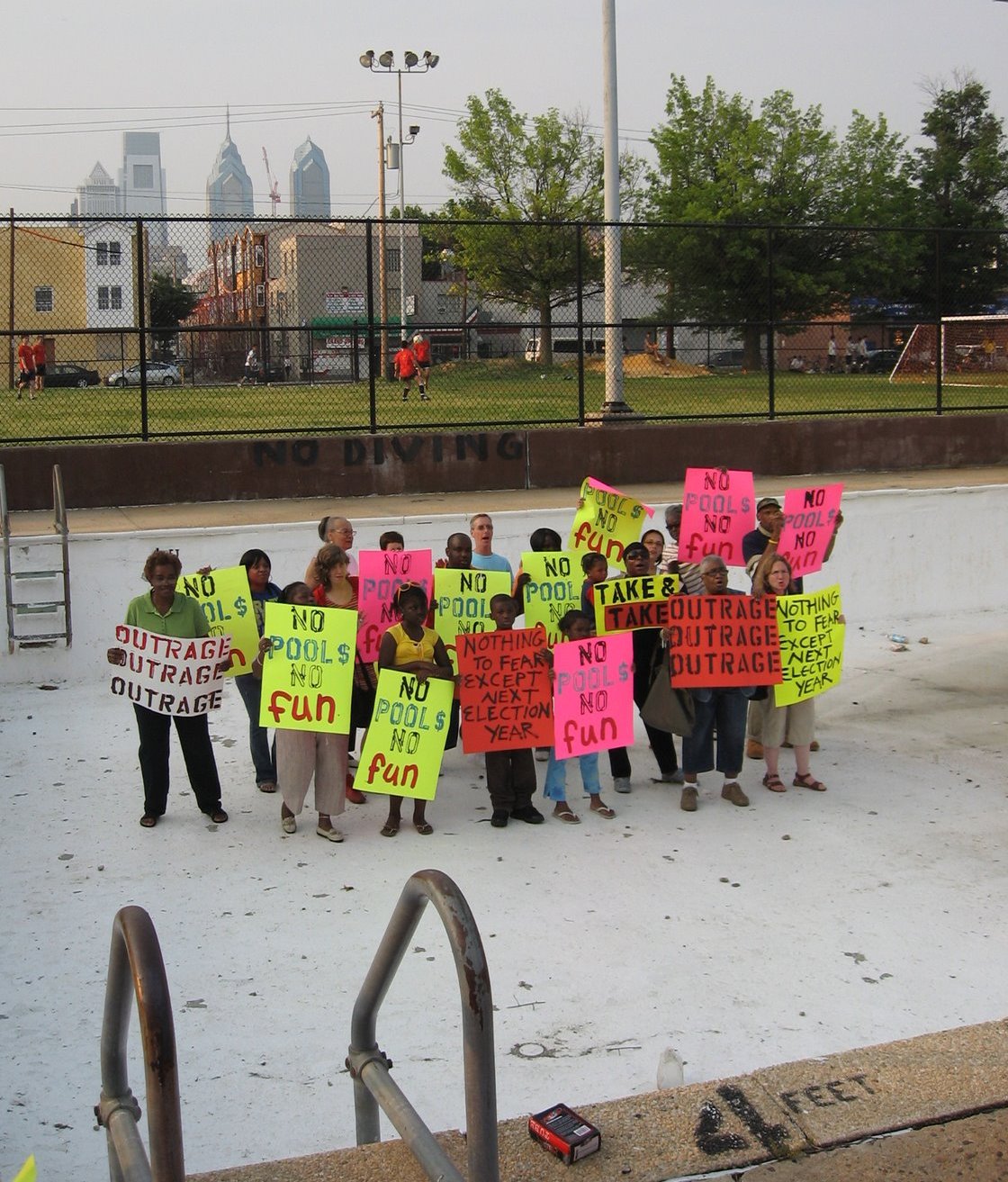
Community rally in 2009’s empty pool. Photo by Coalition to Save the Libraries.
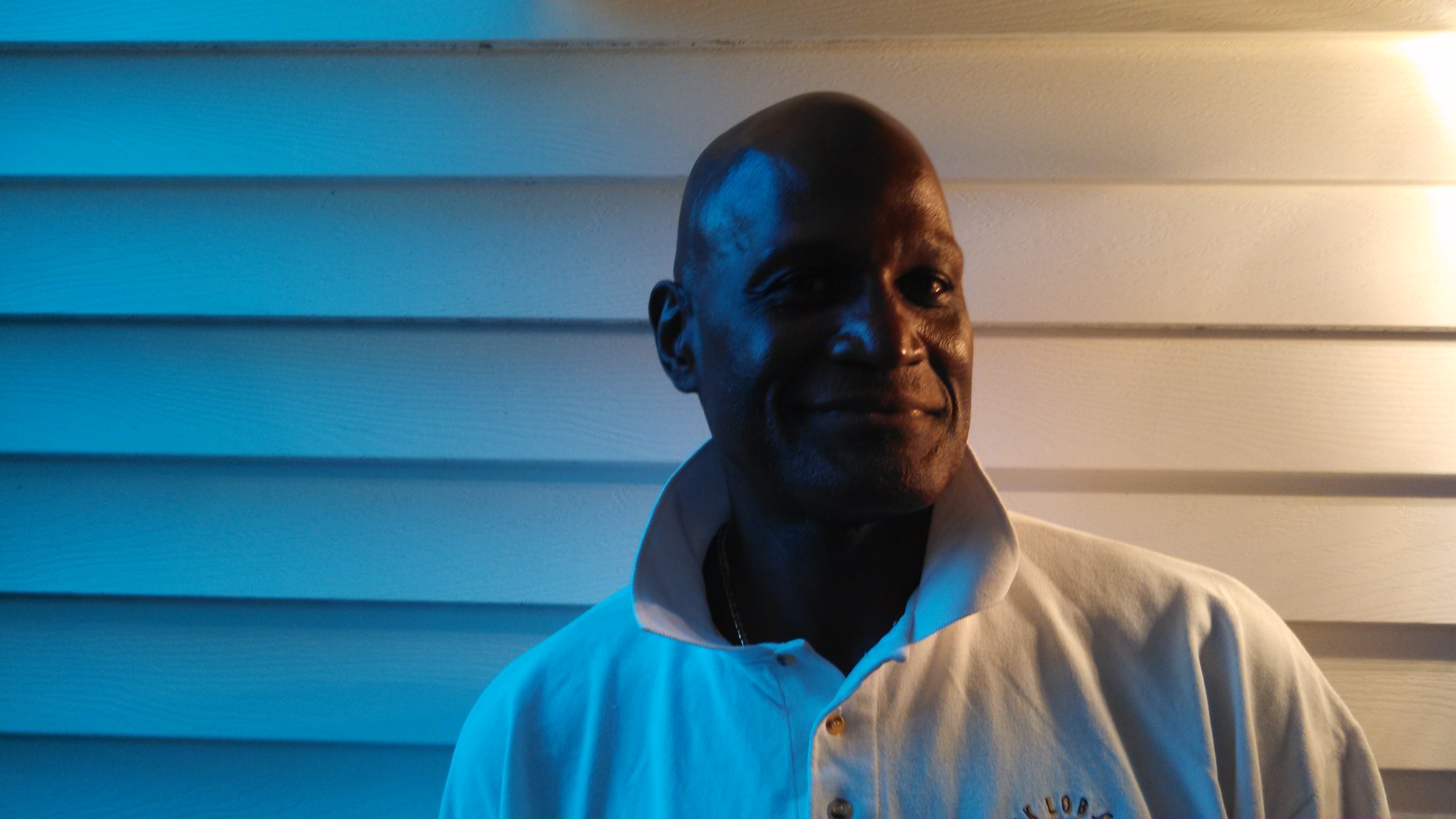
Age: 59
From: Strawberry Mansion
First pool experience: Rice Pool (now closed) at 32nd and Ridge in 1968, when his father pushed him into eight feet of water and taught him to swim
Work with the pools: As a lifeguard at 12th and Cambria, Herron, Finnegan, Chew and Murphy Pools since the mid-1970s
Rodger Caldwell likes to share. Smile at him, and stories come tumbling out. Bring him in as a lifeguard – as the City of Philadelphia has, at pools across the city, for nearly 40 years – and he will, as he describes it, “blow the neighborhood wide open.”
Rodger’s been a lifeguard in North and West Philly, but the pool he describes as “his” is Herron, the much-loved circular pool that cooled the community at 2nd and Reed in South Philly until it closed a few years ago. “There was a lot of Afro-American kids, and in the late eighties they were looking at me like this on the fence,” he remembers, holding his hands up to his eyes like goggles, or the openings on a chain-link fence. “Little kids come up, say, ‘Mister, can we come in?’ And I’m saying, ‘Sure, you can come in!’ Everybody kept saying, ‘Rodger, what are you doing, what are you doing?’ So I kept saying to them, ‘Listen guys, this pool is free! I don’t own this, you don’t own this. Don’t nobody own this, man. This is a city pool! These are kids! You don’t want to have kids go home and cry.’ So the little Afro-American kids came in. The Spanish kids came in behind them. Then some Italian kids start coming in. So basically, my pool became, in the late 80s, I would say, one of the first multi-racial pools in South Philly.”
Rodger was born in Virginia and grew up in Strawberry Mansion, where he still lives today. The most athletic of nine brothers and sisters, he played basketball and – when he was 14 – learned to swim from his father, who’d take him to the city pool around the corner after coming home from work. In the mid-1970s, Rodger was a lifeguard at the 12th and Cambria Pool when the City recruited him to become head guard at Herron. “The City of Philadelphia had a meeting downtown at Rizzo Rink, and they said we need one of the best lifeguards you got to come down here and – I guess what they wanted to say was see if he can take back our facilities from the community. The community basically took over. They started putting water inside the pool from the plug, and they was running the pool themselves. All Irish. Irish and Polacks. Wasn’t nobody down there, you know, no color of skin. No Italians, no Chinese – nobody! So they had a meeting with me down there at Rizzo Rink, some of the big shots for the City, and they said, ‘Rodger, we’ve got a special job for you. We wanna know, can you handle it? Can you do it?’”
“So I walked over there – I was a skinny Afro-American guy, real thin. And they looked at me; I looked at them. The kids looked at me; the adults looked at me. The older men and some of the guys on the corner drinking beer, they didn’t like me at all. Boy, they let me have it.”
“So if I went in on a Sunday, and I came in that next day Monday, I started putting up my rules and regulations. And in two weeks time, three weeks time, the kids fell in love with me. Five years old, six, seven, eight, nine, ten – all up to maybe fifteen – they fell in love with me. And once the children fell in love with me, then the parents started liking me. Then the grandfathers started liking me. Then the grandmothers started liking me.”
“When I came back that next season, I put up my rules and regulations again, and I’m starting to see a change. I started my swimming team. I started things for seniors. I started night swimming. See back then, the pools would close at nine o’clock at night. And we had lights that lit up the pool, and it was gorgeous.”
“And you gotta remember now, I’m the only dark guy around. And they took a liking to me. Every two or three days, people was bringing me food. And then the men from the Del Monte ship that was coming in on the port – because the whole area down there, 2nd and Reed, was basically Longshoremen. Everybody worked on the ships, I mean everybody. And they were bringing in oranges, apples, bananas, pineapples, grapes. And they would say to me, ‘Rodg, could you give them out to the community?’ Because the kids in the community loved me. And every day, I used to have people stand in line, and I gave out bananas; I gave out pineapples. And all these little blond haired, blue-eyes kids was loving me like they my children!”
“My swimming team was very, very good. I’m talking about very good. I think when the kids fell in love with me was how strict that I always was. I mean I came down there, put down rules and regulations, and then the kids seen me teach them how to swim. These little kids was going home, getting bathing caps, swimming gear, everything like that. If you mention Rodger Caldwell at 2nd and Reed, they’ll go back and say yeah, he put our children on the map as far as swimming. Because a lot of those kids today, they can swim because of me. And my career stretched for over twenty-some years at that pool.”
Working as a School District bicycle cop from September to June, Rodger has kept his summers free for the pools. He never wanted to leave Herron but did for a month in the mid-1990s, when the City asked him to go meet with the community around the James Finnegan Rec in Southwest and troubleshoot racial tensions that were bubbling over. (He set up a schedule in which there were certain swim times for every age group. Once it was just eight- and nine-year-olds or fifteen- and sixteen-year-olds, it seemed whites and Blacks didn’t have a problem swimming together.) Since Herron closed – when a crack in the pool floor started leaking water into the surrounding houses, and the cost of repair was too great (the site is now a sprayground) – Rodger’s served as head lifeguard at South Philly’s Chew and Murphy Pools. He speaks proudly of welcoming new communities into the water at both – Latinos and whites at Chew at 18th and Washington; people of color, and especially Asians, at Murphy at 3rd and Shunk. “I love everybody,” he smiles.
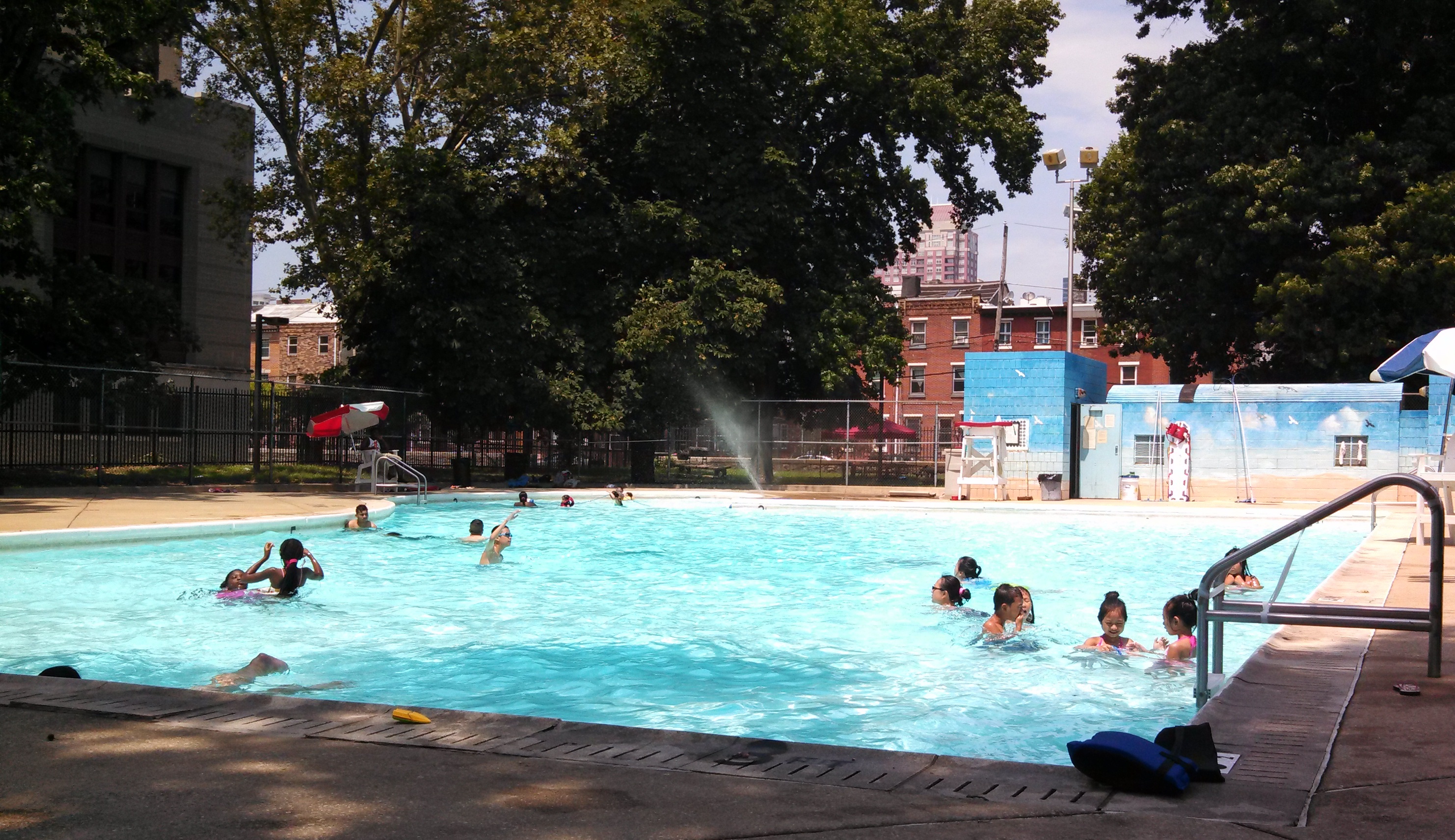
Ridgway has many fans. Shiny blogs like Daily Candy and Curbed Philly endorse it. My landlord loves it. And I once sat beside an especially loud and tattooed fellow at an East Passyunk coffee shop who went on about it with great passion. It’s actually now my home pool, though it’s not the one I visit the most. The first time I went (in 2007), it was so full of kids that if you dunked under the water you practically had to check to make sure none of them had swum above your head before you popped up again. I have heard and noticed (thanks to the clear view of the pool from the 13th Street sidewalk) that it’s much less crowded these days.
Nestled under the trees behind the many-pillared High School for Creative and Performing Arts (CAPA), Ridgway is a “detached pool,” meaning that there’s not a rec center right beside it. (Until the early 1990s, there actually was a Ridgway Rec in the basement of the building that’s now CAPA’s – and was formerly the Ridgway Library – but it was displaced by the City’s development of South Broad into the “Avenue of the Arts.” In 1997, the Department of Parks and Rec opened the Hawthorne Cultural Center at 12th and Carpenter, and it’s now the rec affiliated with Ridgway. HCC’s mandate to integrate dance, music, and visual arts into the regular athletic-recreation programming has contributed a beach-scene mural to the wall of the pool shed.) The pool’s shape (something like a rectangle with a large lima bean popping out of one corner) isn’t one designed for traditional lap swimming, and there’s a very cool sprinkler that rains down over the two-foot-deep section. The attendants may ask you to sign in as you enter, and you’re welcome to bring your stuff in with you.
You can get to the pool gate from a path that starts at the corner of Broad and Carpenter.
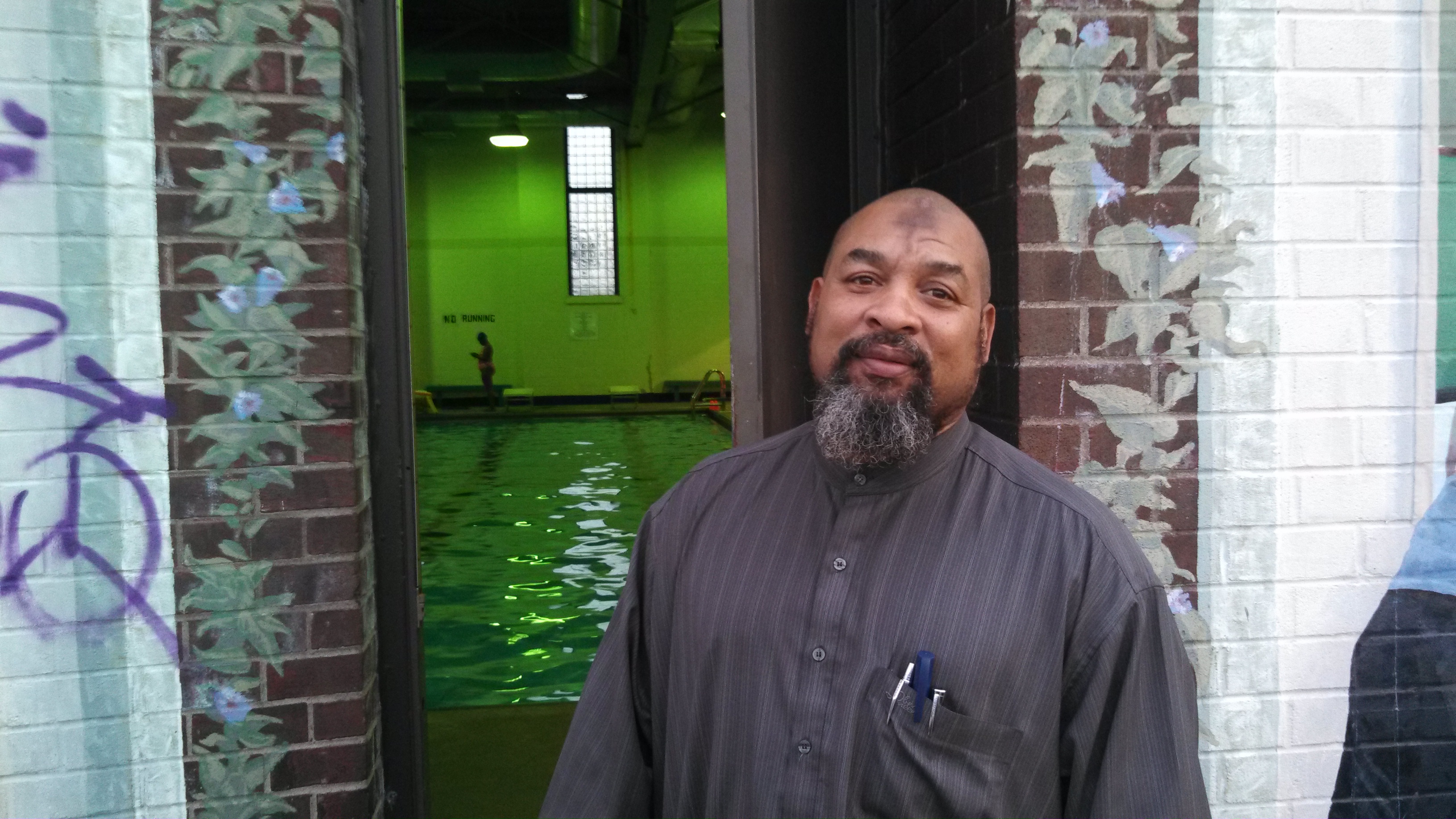
Age: 56
From: West Philadelphia
First pool experience: Kelly Pool in 1961
Work with the pools: As a lifeguard, Water Safety Instructor (WSI) and Lifeguard Instructor (LGI) at Sayre-Morris Pool since 1989
Larry Brown’s face lights up when he talks about swimming. “Swimming, it’s an art. Kicking your feet, using your arms, sucking the air in, blowing it out under the water. When your legs kick six times, your arms move once. We need to take more time out to show children how to swim,” he says. “It gives them an outlet to do something that other athletes can’t do. A lot of athletes can’t swim. They’re scared of the water! I’m talking, you’ve got major athletes, who make millions of dollars, scared to put their foot in the water. So now you have somebody, right, doesn’t make all that money, doesn’t have all that fame, can get in and swim without drowning. That’s important.”
Larry knows something about showing children how to swim. At Sayre-Morris Pool since 1989, he’s taught hundreds of West Philly kids. “The most rewarding experience is seeing little kids develop into swimmers, or develop into lifeguards,” he says, smiling. And anyone who’s ever taken a lifeguarding course with Larry (including me) knows that every session starts and ends with swimming laps – and a reminder of the how important it is to swim, and let others see you doing it.
Opening his hands toward the swimmers gliding back and forth through Sayre’s clear blue water, he explains: “It’s a sport where it’s only you. You gotta go up; you gotta come back. Nobody can do it for you.”
Larry is the only one of Philadelphia’s seven Water Safety and Lifeguard Instructors who’s worked at the same pool since he started — and his history with Sayre-Morris goes back much farther than his employment. Larry remembers the pool opening when he was a young teen in the early 70s. “Back then it was gang war. I would come up here knowing that I would get chased. Most of the time I got chased back down home. This is 58th Street; I was from back down 52nd Street. So I wasn’t supposed to come up here. I still would come. After a while I used to come so much that I became friends with the guys up here that was gang-warring the way I was gang-warring. I became their friends. Until this day some of their children play out here; some of their grandchildren I see.”
“Miss Cart was here then. I used to see her out front. I got to know her, and she got to know me. ‘Boy, where you coming from? You’re always here.’”
After getting kicked out of all-boys St. Thomas Moore for discipline problems, Larry graduated from South Philly’s Bok Technical High School (one of the 24 public schools the School Reform Commission shuttered last June) in 1975. After graduation, he joined the Army, where his roommate was a medic, with a penchant for – and access to – hard drugs. Larry was a boxer, and the boxing kept his own drug use in check – until he got out of the service in 1982.
“Before I started actually swimming distance, and getting into the mechanics of swimming, I was a drug addict. That’s all I had time for. And then every now and again, even when I was a drug addict, I would come to the pool. After a while, I got interested into the water, went to rehab. Even when I was at rehab, I was swimming. Then when I came back from rehab, I just took it to another level. I started coming to Sayre every day, to keep myself busy. People in my family that I got high with was betting that I would get high again, and this was just a move I was making for the time being. ‘Just wait, a couple more weeks, and he’ll be knocking on the door with money in his pocket, talking about let’s get it on.’ It didn’t happen. Thank Allah that it didn’t happen.”
He laughs, “It’s been a party ever since. That’s the real party. The real party is being able to not get high, and having money in your pocket. If you got high, you wouldn’t have money in your pocket. Been clean ever since.” Larry was at Sayre so much those days that they eventually asked him if he wanted a job. He’s been there ever since too.
“Larry does a lot,” one of the Sayre lifeguards he supervises commented the day I was there to interview him. “He takes pride,” another replied. In addition to pool inspecting and leading swimming lessons, lifeguard trainings, twice-weekly water aerobics, and boating safety classes, trying to maintain the pool itself is a significant endeavor.
“The pools are not being kept up,” he sighs. “There’s a lot of stuff, even in here, that could be fixed. They just – nobody cares. I think before some major work happens in here, this pool will be shut down. Or the University of Penn or Drexel will own it before some major stuff goes. So we just try to maintain.” He and Sayre’s other Water Safety Instructor Thelma once drained the pool and painted it themselves. It took a month and a half – but otherwise it wouldn’t have happened.
“It gives the kids an outlet during the summer, to be able to go to a pool. Some people in the communities don’t have air conditioning. Some kids don’t have running water. So sometimes this is an outlet to cool off, and sometimes this is an outlet for kids to bathe themselves. I mean, to be truthful! Some kids don’t have running water. That’s why, during the fall, the winter, a lot of kids won’t go to school. For one, they don’t have water to wash their clothes or to wash themselves. So they smell, and other kids keep teasing them. This is an outlet in many ways. You know, you use the pool – it’s not supposed to be used for bathing. And we know that. But sometimes it’s an outlet for people that don’t have.”
“I would like my children and grandchildren to inherit the good times I had at the pools. It’s a lot that’s going on in the neighborhoods that I would like them not to inherit. But it’s gonna be hard. The schools are a mess. We had an abundance of schools with pools that the Department of Rec used to run. They closed. So now they’re talking about maybe four pools compared to eight or ten at one time.”
Larry has been married for 35 years, with five biological and adopted children (four of whom worked as lifeguards at one time). His mother, who taught him to swim, now has Alzheimer’s, and he’d been up most of the night before our interview looking for her after she’d gone out and gotten lost. He also works another job as a court representative for Youth Services Agency of PA, a nonprofit that works with young people caught up in the criminal justice system. When I ask him if there are any other roles he plays, he answers, “Just being a Black leader. I don’t really call myself a leader, but we have a lot of children out here, who there’s nobody to look up to. They don’t see people that come and swim every day, or come to work every day. They don’t see that. But then again, if they look around, they will see it, because I’m here every day. I’m here now, and I’m sick. Thelma comes here if she’s sick. We always come.”

View of the pool from the bleachers.
In my experience, Marian Anderson is consistently the calmest pool in South Philadelphia. So much at the pools can vary from year to year, from day to day, and even from hour to hour. But in the seven years I’ve been visiting Anderson, there has always been space to swim from one end of the pool to the other without bumping into another swimmer.
Everyone who swims here showers before entering the pool, because the shower is set up over the pool gate so there’s really no way around it. You need to undress and leave your things on cement bleachers outside the chain-link fence (raised up from and separated from the street by another fence, and clearly visible from the pool). The pool itself is an irregular pentagon shape, with big trees shading the deep end (or deep-er end, at 4 feet 10 inches) and a view of Center City’s buildings beyond. There are lines on the bottom of the pool for lap swimming, and I met a man last summer who was learning how to swim from the “old heads” (his words) who do laps here on weekday afternoons.
Originally called McCoach Playground, the rec center bounded by Fitzwater and Catharine Streets to the north and south and 17th and 18th to the east and west was re-dedicated in honor of Marian Anderson in 1954. Anderson, the legendary contralto and trailblazer (among her many accomplishments: being the first African American to sing with New York’s Metropolitan Opera), was born in Philadelphia in 1897 and grew up in this area. The Marian Anderson Historical Society at 762 South Martin Street, in a house where she lived for nearly twenty years, sits a block and a half from the pool.
A few days after Anderson’s death in 1993, the Inquirer’s Acel Moore remembered her (and the neighborhood in which they’d both grown up) in a piece that includes this pool history: “The old facility was the only playground in South Philadelphia where black children were welcome, and its outdoor swimming pool was the only place in the city – other than the Christian Street YMCA – that blacks could go swimming, public or private, up until the mid ’50s.” Knowing that, it makes even more sense that this particular pool is named for this great Philadelphian.

I was excited to find this book (written by Jeff Wiltse, a history professor at the University of Montana; published by the University of North Carolina Press in 2007) at the Free Library of Philadelphia.
I was even more excited that the Introduction begins:
In 1898 Boston’s mayor Josiah Quincy sent Daniel Kearns, secretary of the city’s bath commission, to study Philadelphia’s bathing pools. Philadelphia was the most prolific early builder of municipal pools, operating nine at the time. All but three were located in residential slums and, according to Kearns, attracted only “the lower classes or street gamins.” City officials had built the austere pools during the 1880s and 1890s — before the germ theory of disease transmission was popularly accepted — and intended them to provide baths for working-class men and women, who used them on alternating days.The facilities lacked showers, because the pools themselves were the instruments of cleaning. Armed with the relatively new knowledge of the microbe, Kearns was disturbed to see unclean boys plunging into the water: “I must say that some of the street gamins, both white and colored, that I saw, were quite as dirty as it is possible for one to conceive.” While the unclean boys shocked Kearns, blacks and whites swimming together elicited no surprise. He commented extensively on the shared class status of the “street gamins” and their dirtiness but mentioned their racial diversity only in passing. Nor did racial differences seem to matter much to the swimmers, at least not in this social context. The pools were wildly popular. Each one recorded an average of 144,000 swims per summer, or about 1,500 swimmers per day.
In the first chapter, Wiltse mentions that one of the first municipal pools in the U.S. was Philadelphia’s “swimming bath,” which opened in June 1884 at 12th and Wharton Streets. I live about fifty feet from that intersection (where, sadly, there is no longer a pool). I cannot wait to read more.
 Swimming Philadelphia